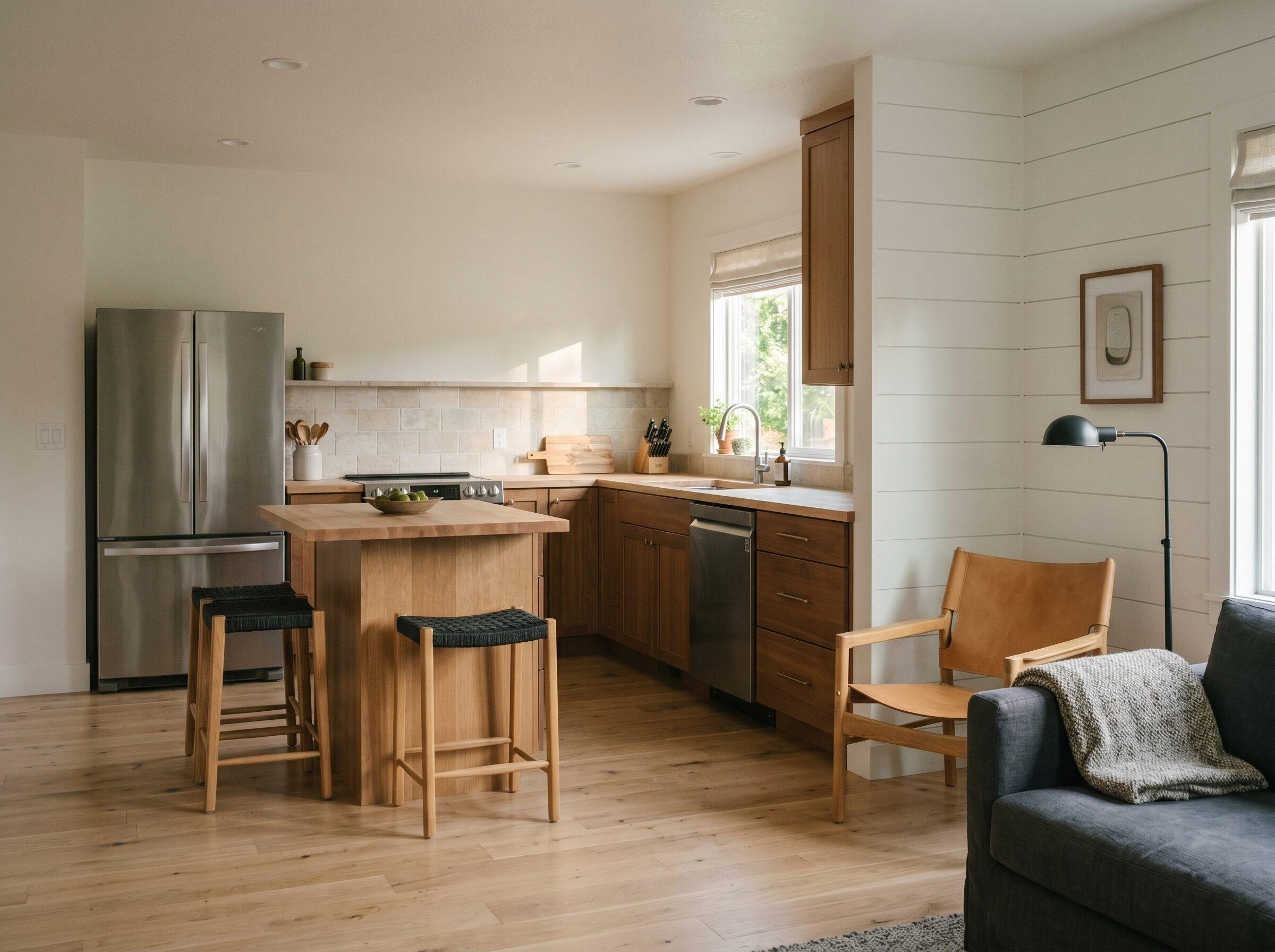
An ADU for aging parents — privacy, proximity, and a lower lifetime cost
Updated: May 2026
A single-level pre-approved Boise ADU lets an aging parent keep their own front door and their own kitchen — steps from family, not 90 minutes away. Below: the plan picks, the accessibility build-ins, and the cost comparison against Boise assisted living.
A Boise ADU for an aging parent typically costs $170k–$245k turnkey for a single-floor 1-bedroom Kingfisher (491 sq ft) at Essential to Standard finish. The comparison point: median Idaho assisted living is $5,000/month (Genworth 2024 Cost of Care), and Boise assisted living specifically runs $3,125–$4,488/month per the same survey. At that monthly cost, a Kingfisher build pays back in roughly 4–6 years against assisted-living spend — and the ADU remains a permanent, appreciating asset on the family lot. National 2025 assisted-living median is $6,200/month per the CareScout 2025 Cost of Care survey, putting Boise on the lower end of the national band.
Why an ADU fits for an aging parent
An ADU keeps a parent independent — their own front door, their own kitchen, their own bathroom, their own morning routine — while putting them steps from family if anything goes wrong. That's the structural advantage no facility can match: privacy in normal life, proximity in a crisis.
It also reduces caregiver burden on adult children. A parent 100 feet away across the patio is dramatically easier to support than a parent 90 minutes away by car or in a facility that requires a scheduled visit. Daily check-ins happen naturally over coffee instead of as a logistical event. For families with school-age kids, the grandparent-grandchild relationship gets the kind of casual, unscheduled time that doesn't exist in any other living arrangement.
Familiar surroundings matter too. A parent who has lived in Boise for decades doesn't get uprooted to a facility in a different neighborhood; their doctor, their pharmacy, their church, and their friends stay reachable. That continuity is the single biggest predictor of how an older adult adjusts to a new living arrangement.
Accessibility-first plan picks
All six City of Boise pre-approved plans are single-story — exactly what aging-in-place requires. Two stand out for this use case, with a third worth considering when a covered, attached entry matters.
491 sq ft, 1 bedroom, single-level. The most common pick for an aging-parent build — a real walled bedroom, a full kitchen, and a distinct living room without unnecessary square footage to clean or heat.
Best fit: One parent living independently, with periodic family or in-home support.
$170k–$245k turnkey (Essential to Standard finish)
695 sq ft, 2 bedrooms, single-level. The largest pre-approved plan in Boise — the second bedroom is the swing room for a visiting caregiver, a spouse, or visiting grandkids.
Best fit: A parent who may need a live-in caregiver or has a spouse, or who hosts family regularly.
$235k–$315k turnkey (Essential to Standard finish)
376–396 sq ft studio with attached garage. Useful when an entry that doubles as a caregiver mudroom matters, or when a converted garage drove the project in the first place.
Best fit: Single occupant who values a covered, weather-protected entry and ground-level storage.
$140k–$215k turnkey (Essential to Standard finish)
All six plans are capped at 900 sq ft per the 2023 Boise Modern Zoning Code, with a maximum of 2 bedrooms. The full plan catalog walks through the rest.
Build accessibility in from day one
Six items are dramatically cheaper to build in at framing than to retrofit later. None individually adds meaningful cost during construction; together they're the floor of a real aging-in-place build.
36-inch interior doors
Wide enough for a walker, wheelchair, or aide alongside the parent. Adds roughly $500–$800 across the whole ADU at framing. Retrofitting later means new jambs, new trim, often new flooring at the threshold.
Zero-threshold curbless shower
A curbless shower with a linear drain costs about the same as a tub-shower combo during construction. Retrofitting one later runs $8k–$15k and three weeks of disruption — cut tile, move plumbing, re-waterproof.
Grab-bar blocking in framing
Solid plywood blocking behind drywall at the toilet, shower walls, and tub. Costs roughly $200 in materials. Without it, installing grab bars later means cutting drywall, patching, and repainting.
Lever hardware + rocker switches
Lever door handles and paddle light switches are easier with arthritic hands than knobs and toggles. Cost difference is $5–$10 per fixture. Specify at design freeze.
Single-level open plan
All six Boise pre-approved plans are single-story. No stairs at 80, ever. An open kitchen-to-living line of sight gives a walker room to maneuver and a caregiver clear sightlines.
South-facing windows + good lighting
South-facing main-room windows help with the seasonal-affective issues that affect older adults at Boise's latitude (44°N) from December through February. Layered lighting reduces fall risk after dark.
The full design checklist — kitchen specifics, bathroom specifics, non-slip flooring choices, comfort-height toilets — is in the planning guide.
Net read: a Standard-finish Kingfisher pays back against Boise assisted living in roughly 4–5 years at the low end of the cost band, sooner at the high end. From year 5 onward, the family avoids ongoing assisted-living spend entirely and holds an appreciating asset on the lot.
Planning, legal, and estate considerations
The build is the easy part. The financing structure, title structure, and Medicaid implications are where families get surprised — and where the right professional input early saves real money later.
Medicaid 5-year look-back: Idaho Medicaid (administered by Idaho Health & Welfare) reviews asset transfers in the 60 months before a long-term-care Medicaid application. A parent who funds an ADU build (or transfers significant assets to adult children to do so) and then needs Medicaid within five years can face an eligibility delay. This is the single most important reason to talk to an elder-law attorney before the construction contract is signed.
Title structure: Whether the parent is on title, holds an equity interest, or is treated as a tenant of the adult child's property has gift-tax, step-up-basis, and estate-planning implications. Common structures: the adult child builds and owns the ADU outright; the parent contributes via a documented intra-family loan; or the parent funds the build and the property is held with right of survivorship. Each path has different tax outcomes — none is universally right.
Property tax: Idaho's homestead exemption applies to a single primary residence. Adding an ADU increases the assessed value of the parcel; the impact on annual property tax is typically modest but should be confirmed with the Ada County Assessor before the build, not after.
The transition: When the parent eventually moves to a higher-acuity facility or passes, the ADU transitions cleanly to a long-term rental. Boise removed owner-occupancy in the 2023 zoning rewrite, so leasing is permitted without restriction. See ADU rental income in Boise for the playbook on transitioning the unit and the rents to expect.
Permits and timeline
A pre-approved Kingfisher or Kestrel permits in roughly 3–5 weeks in Boise (versus 7–12 weeks for a custom plan), then builds in 14–18 weeks. Start-to-keys is typically 5–7 months for a pre-approved single-floor build with a standard finish. The process page walks through each phase; the permit-process guide covers exactly what reviewers check and the most common holdups. Construction is handled by our partner builder Iron Crest Remodel (Idaho contractor license RCE-6681702), a fully licensed and insured Boise general contractor.
Boise ADU for aging parents — frequently asked
How much does a Boise ADU for an aging parent cost?
A single-floor Kingfisher (491 sq ft, 1BR) runs roughly $170k–$245k turnkey at Essential to Standard finish. A Kestrel (695 sq ft, 2BR) runs $235k–$315k. Both are pre-approved Boise plans built to current code, including site work, permits, finishes, and accessibility build-ins specified at framing. Add roughly $5k–$15k if you upgrade to a curbless shower, comfort-height fixtures, and lever hardware as a package — most families consider that the floor of an aging-in-place build, not an extra.
What's the best pre-approved plan for an aging parent?
The Kingfisher (491 sq ft, 1BR) is the most common pick — a real walled bedroom, a full kitchen, a distinct living room, and the smallest single-bedroom footprint in the pre-approved set. The Kestrel (695 sq ft, 2BR) is the right choice if a live-in caregiver, spouse, or routinely visiting family is part of the picture. All six pre-approved plans are single-story, which is the single most important design choice for aging in place.
ADU vs assisted living — which is cheaper in Boise?
Over a 5-year horizon, an ADU almost always costs less. Boise assisted living runs $3,125–$4,488 per month (Genworth 2024), which is $37,500–$53,856 per year or $187,500–$269,280 over 5 years — with no asset at the end. A Standard-finish Kingfisher at $200k is paid back in roughly 4–5 years against that monthly cost, and the ADU remains a permanent appreciating asset on the family property. The honest caveat: an ADU does not include the personal-care staffing, medication management, or 24/7 supervision that assisted living provides.
Can the ADU later become a rental?
Yes — and that's a major reason to build to rental-grade specs from day one. Boise removed the owner-occupancy requirement in the 2023 zoning rewrite, so when the parent moves out or passes, the unit can lease without retrofitting. A Kingfisher rents in the $1,400–$1,700 range long-term in most Boise neighborhoods today. See the rental-income page for the full numbers and the playbook for transitioning the unit cleanly.
What accessibility features should we build in from the start?
Six items pay for themselves many times over because retrofitting later is brutal: 36-inch interior doors, zero-threshold curbless shower with a linear drain, grab-bar blocking in framing at the toilet and shower walls, lever door hardware, rocker light switches, and a comfort-height (17–19 inch) toilet. None individually adds meaningful cost during construction. All six together are roughly a $3k–$6k upgrade at build, versus $20k–$40k to add later.
Are there tax or estate-planning issues we should know about?
Several, and they're situational. Medicaid has a 5-year asset look-back on transfers — a parent who funds an ADU and then needs Medicaid within 5 years can face an eligibility delay. Idaho property tax may shift slightly if the parcel adds an ADU; the homestead exemption applies only to a single primary residence. Title structure (parent on title, partial gift, intra-family note) has gift-tax and step-up-basis implications. None of this is hard to handle — but you want an elder-law attorney and a CPA looking at it before the build contract is signed, not after.