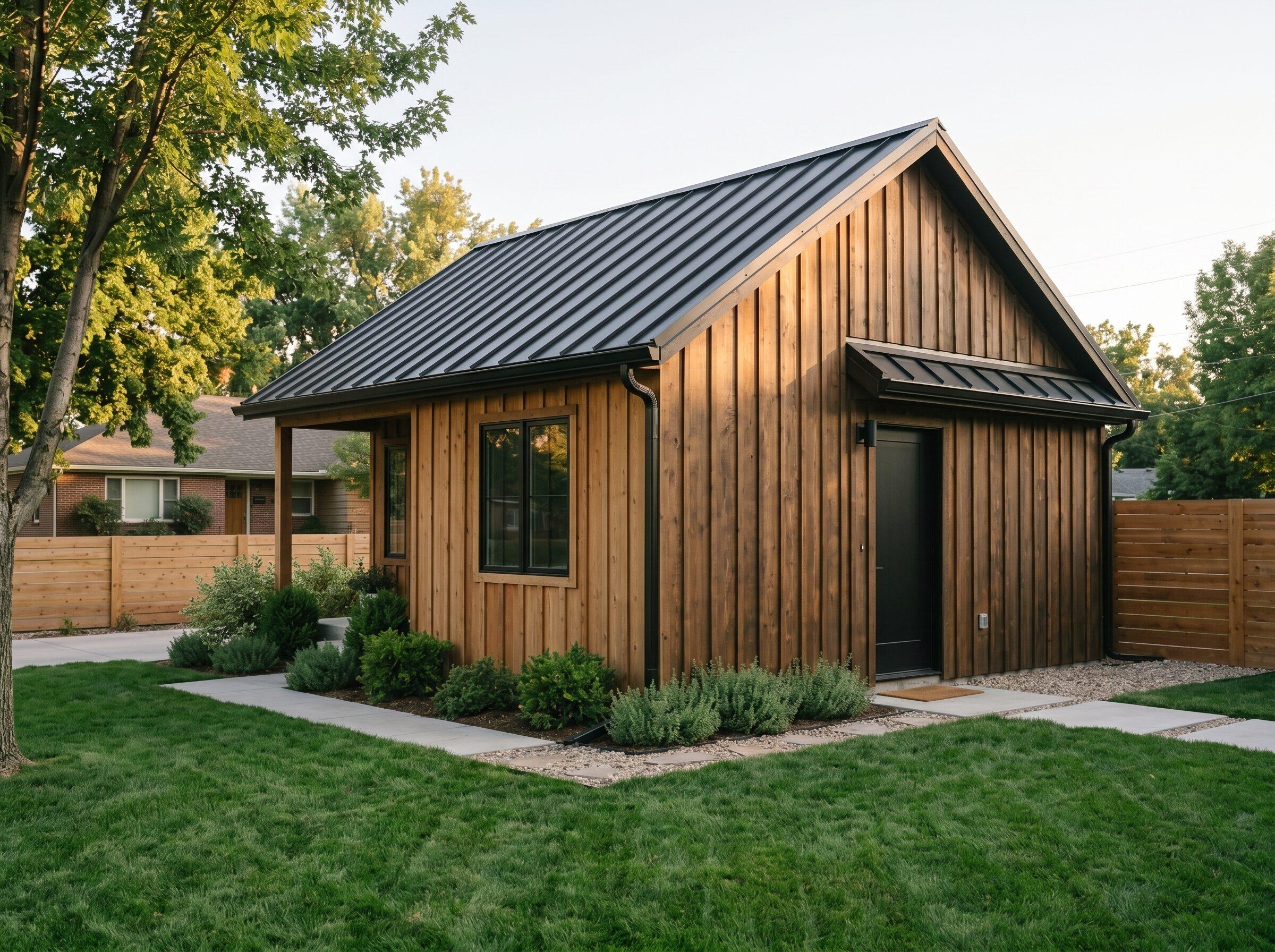
House hacking with a Boise Kingfisher ADU typically offsets $1,000-$1,400/mo of an average Ada County mortgage payment — turning a ~$2,800/mo PITI into roughly $1,400-$1,800/mo net carry. Below: the real 2026 math, both occupancy paths, financing options, and an honest read on the risks.
A Boise 1-bedroom ADU rents for $1,479-$1,503/mo at the city-wide median in May 2026 (Apartment List + RentCafe). Builder estimates run more conservative — Iron Crest Remodel publishes a $1,100-$1,500/mo range for 1BR ADUs as a planning floor. Use $1,100-$1,500 if you want a conservative pro-forma and $1,479-$1,503 if you want the actual market median. Either way, on a typical $450k Ada County starter home with ~$2,800/mo PITI, that rent offsets enough debt service to drop the owner's net carry by roughly half.
Why house hacking works in Boise now
Before December 1, 2023, you had to live on-property to legally operate an ADU as a rental in Boise. The Modern Zoning Code removed that requirement. Both units are now legal to rent. You can live in the main house, live in the ADU, or rent both and live elsewhere — all three are clean configurations under the current code. That's the linchpin that makes Boise house hacking simple in 2026: there's no occupancy-tripwire to accidentally violate, and the typical owner-tenant friction of older ADU programs is gone.
The other 2023 changes matter too. Maximum ADU size moved from 700 sq ft to 900 sq ft (or 50% of the primary dwelling, whichever is less). The off-street parking requirement was eliminated. Permit volume jumped 9× in the first three months after the rewrite — roughly 27 ADU permits per month vs ~3 per month under the old code, per Sightline Institute. The legal and operational headwinds that made house hacking fiddly before 2024 are gone.
Two paths — live in main, or live in ADU
Both are legal post-2023. The right one depends on your space needs, your tolerance for downsizing, and which side of the property generates more rent.
Most common setup
Live in the main house · rent the ADU
Fits: Owners who want to keep the space they already have, run a quieter long-term tenancy out back, and treat the ADU as a 5-10 year income asset.
Pros
Owner keeps full main-house square footage and storage
ADU rents to one tenant or a couple — lower turnover, lower wear
Easiest mortgage path — owner-occupied loan on the primary stays clean
Watch-outs
Lower gross rent than renting the main house ($1,479-$1,503/mo 1BR median vs $1,900-$2,800/mo for a 3BR)
Tenant lives in your backyard — shared driveway and trash day need ground rules
Higher gross cash flow
Live in the ADU · rent the main house
Fits: Empty-nesters, downsizers, or owners who want to maximize rental income and don't need the main-house square footage day to day.
Pros
Higher gross rent — a 3BR Boise rental typically clears $1,900-$2,800/mo per Apartment List medians
Owner controls a smaller, newer footprint — lower personal utility and maintenance load
Bigger long-term equity build because more of the property is income-producing
Watch-outs
Tighter living for owners with kids or large furniture — 491-695 sq ft is intentional downsizing
Some owner-occupied loan products treat 'main house as rental' as a fact pattern to underwrite carefully — talk to your lender early
The math — real numbers on a Kingfisher build
Worked example for the most common house-hacking configuration: owner lives in the main house, rents the ADU long-term. All figures sourced from the research files; no fabricated inputs.
Line item
Value
Source
Main-house value (Ada Co. starter)
$450,000
Boise metro median starter band
Current 30-yr fixed (Idaho)
6.88%
Bankrate Idaho, May 2026
Main-house PITI
~$2,800/mo
20% down, taxes + insurance included
Kingfisher ADU build (Standard finish)
~$200,000
/adu-cost-boise pricing grid
ADU financing (construction-to-perm)
6.75%
MACU construction loan, May 2026
ADU monthly debt service (~30-yr amortization)
~$1,300/mo
Principal + interest on $200k @ 6.75%
ADU monthly rent (Boise 1BR median)
$1,500/mo
Apartment List + RentCafe, May 2026
Net carry on the primary residence
~$1,400-$1,800/mo
After ADU rent offsets ADU debt service + a slice of main-house carry
Assumes owner-occupied loan on the primary, construction-to-perm on the ADU, 20% down on the main house, no second mortgage against existing equity. Property tax bumps on the assessed value increase from the ADU are real and built into the rough net-carry band. The actual number on your lot depends on your existing mortgage rate, down payment, finish level, and tenant stability — the ROI Calculator runs the same math against your specific inputs.
Financing paths
Three common ways Boise house-hackers fund the ADU build. All rates as of May 2026 — verify at quote time, they move constantly.
HELOC on existing equity
6.250% (ICCU, May 2026)
Lowest publicly listed Idaho rate at capture. Variable. Up to 85% combined LTV. Best when you have meaningful equity in the primary residence and want to draw only what each construction phase needs. Variable-rate exposure is the tradeoff.
Construction-to-perm loan
6.750% (MACU, May 2026)
Single-close construction loan that converts to a permanent mortgage. Locks the rate before construction starts, which removes rate risk during the 14-18 week build. Higher friction at underwriting — full docs, full appraisal, draw schedule.
Cash-out refinance
~7.0-7.2% (Idaho estimate, May 2026)
Rolls the ADU build cost into a new primary mortgage. Cleanest accounting — one payment, one rate. Costs you the spread on your existing mortgage if you locked at a lower rate during 2020-2021. Usually the wrong move for owners sitting on a sub-5% loan.
Full path comparison with terms, LTV caps, and lender notes on the financing page.
Tax + refinance basics
When you live in one unit and rent the other, the property splits for tax purposes. The owner-occupied portion keeps Idaho's homeowner exemption (currently 50% of assessed value up to the state cap). The rented portion is investment property — the IRS treats rental income as ordinary income, but you can deduct a proportional share of property tax, insurance, repairs, utilities you cover, and depreciation on the rented footprint. Depreciation on a $200k ADU over a 27.5-year schedule is roughly $7,300/yr of paper expense against rental income, which often pushes the rental side close to or below breakeven on the K-1.
The "house hack to refi to next rental" pattern: live in the property at owner-occupied rates for the minimum occupancy window (typically 12 months), build documented rent history on the ADU during that year, then refinance into a long-term hold once the rental income counts in qualifying ratios. Some house-hackers repeat the move — buy the next owner-occupied property with a new ADU, live there 12 months, refi, repeat. The structure compounds when rates cooperate.
Honest risks
House hacking pencils for most Boise owners with a usable backyard and decent W-2 income. It doesn't pencil for everyone. The four risks below are the ones that actually break the math when they show up.
Vacancy spikes
One- or two-month gaps between tenants cost $1,500-$3,000 in lost rent on a Kingfisher. Budget a one-month-per-year vacancy reserve to smooth the cash flow.
Repair years
HVAC service, roof patches, fence repair, appliance replacement — they don't come every year, but when they do they come together. Reserve about 1% of build cost per year (roughly $2,000/yr on a $200k ADU) so the bad year doesn't blow up the math.
Rate environment risk
A HELOC at 6.25% is great today; the same instrument at 8.5% in two years rewrites the cash flow. If you finance variable, model the carry at +150-200 bps and decide whether the math still pencils.
Tenant friction with a shared lot
Shared driveway, shared trash day, noise. Most friction is preventable with a written lease that spells out parking spots, quiet hours, and trash logistics. Design around it — separate entrances, a privacy fence between yards, and a clear gate path help.
Permits + build timeline
The pre-approved Kingfisher path runs about 3-5 weeks to permit and 14-18 weeks to build — roughly 5-7 months from signed contract to certificate of occupancy. The build is managed by Iron Crest Remodel, Idaho contractor license RCE-6681702. Custom (non-pre-approved) plans add 4-8 weeks at permitting and roughly $8k-$15k in design fees. The pre-approved set is the right call for house-hacking unless your lot demands a custom layout. Full process detail on /process and the permit process guide.
House hacking — frequently asked
How much of my mortgage can a Boise ADU rental offset?
On a typical $450k Ada County starter home with ~$2,800/mo PITI, a Kingfisher ADU renting at the Boise 1BR median of $1,479-$1,503/mo (Apartment List + RentCafe, May 2026) offsets about $1,000-$1,400/mo after debt service on the ADU itself. Net carry on the primary residence typically lands in the $1,400-$1,800/mo range. Larger Kestrel 2BR builds can push offset higher because Boise 2BR median rent is $1,653-$1,745/mo.
Do I still need to live on the property to rent both units?
No. Boise's Modern Zoning Code removed the owner-occupancy requirement on December 1, 2023 (BoiseDev, Hawley Troxell, Sightline Institute). Before that change you had to live on-property to operate an ADU as a rental. Now both units are legal to rent to long-term tenants. You can live in the main house, live in the ADU, or live somewhere else and treat the parcel as a small two-unit investment property. Owner-occupancy still matters for owner-occupied loan pricing — different question.
Which is better — live in the main house or live in the ADU?
Depends on your space needs and your appetite for downsizing. Live-in-main is the most common path because you keep your existing space and add a quieter income stream out back. Live-in-ADU produces higher gross cash flow because a 3BR Boise rental clears $1,900-$2,800/mo while a 1BR ADU clears $1,479-$1,503/mo. The flip works best for empty-nesters, downsizers, and owners whose life genuinely fits in 491-695 sq ft.
Can I get an owner-occupied mortgage if I plan to rent the ADU?
Typically yes, provided you actually live in one of the two units as your primary residence. Owner-occupied loan products (FHA, conventional 5% down, VA where eligible) are priced 0.5-1.5 percentage points below investor loans and accept lower down payments. The ADU rental income is treated as supplemental rather than disqualifying. The structure is well-understood by Idaho credit unions and banks. Disclose plans honestly at application — underwriting handles house-hacking routinely.
What's the realistic gross yield on a Boise house-hacking ADU?
Gross yield runs roughly 9-11% on a Standard-finish Kingfisher in 2026 — $1,500/mo rent on a $200k build is 9.0% gross, $1,650/mo is 9.9%. Kestrel 2BR builds at $250k-$280k renting for $1,700-$1,900/mo come in around 8-9% gross. Net yield (after property tax, insurance, vacancy reserve, maintenance reserve) typically runs 1.5-3 points below gross. House-hacking also captures the owner-occupied-loan rate spread, which is real money the pure-investor math misses.
Will the rental income help me qualify for the construction loan?
Sometimes — depends on lender, product, and whether you have a signed lease in hand. Most Idaho lenders won't count projected ADU rent at underwriting for the construction loan itself because the unit doesn't exist yet. Once the build is complete and rented, that income typically counts at 75% of gross for any subsequent refinance or future purchase. The bigger qualification lever during construction is usually the owner's W-2 income and existing equity, not projected rent.
Start with a free lot check — plan fit, setbacks, utility access, and whether a Kingfisher or Kestrel build pencils for your specific parcel. Or call (208) 297-2036.